


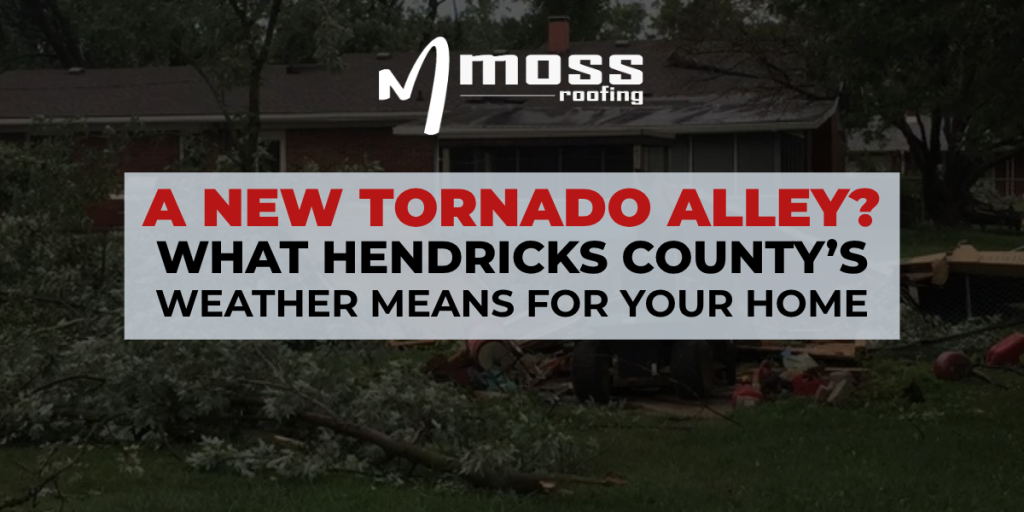
Most Danville storm damage roof claims don’t start with a tornado — they start with a tree. That distinction matters more than you’d think.
Ask anyone who’s lived in Hendricks County a while and you’ll hear some version of the same question: is it just me, or are we getting hit more often?
It’s a fair question. Let’s look at what the record actually shows.
What Hendricks County has actually seen
April 2, 2025 was the big one in recent memory. That night:
- An EF-2 tornado struck Brownsburg with estimated peak winds around 120 mph, traveling roughly 9.5 miles from Brownsburg to northeast of Eagle Creek before lifting near I-65.
- The National Weather Service survey documented sporadic tree and roof damage across the southern portions of Brownsburg, with the most significant damage at several warehouses — including the Sur La Table distribution center, where a wall collapsed with employees inside.
- More than 20 homes in the Branches neighborhood sustained roof and minor structural damage.
- Danville recorded an 81 mph wind gust.
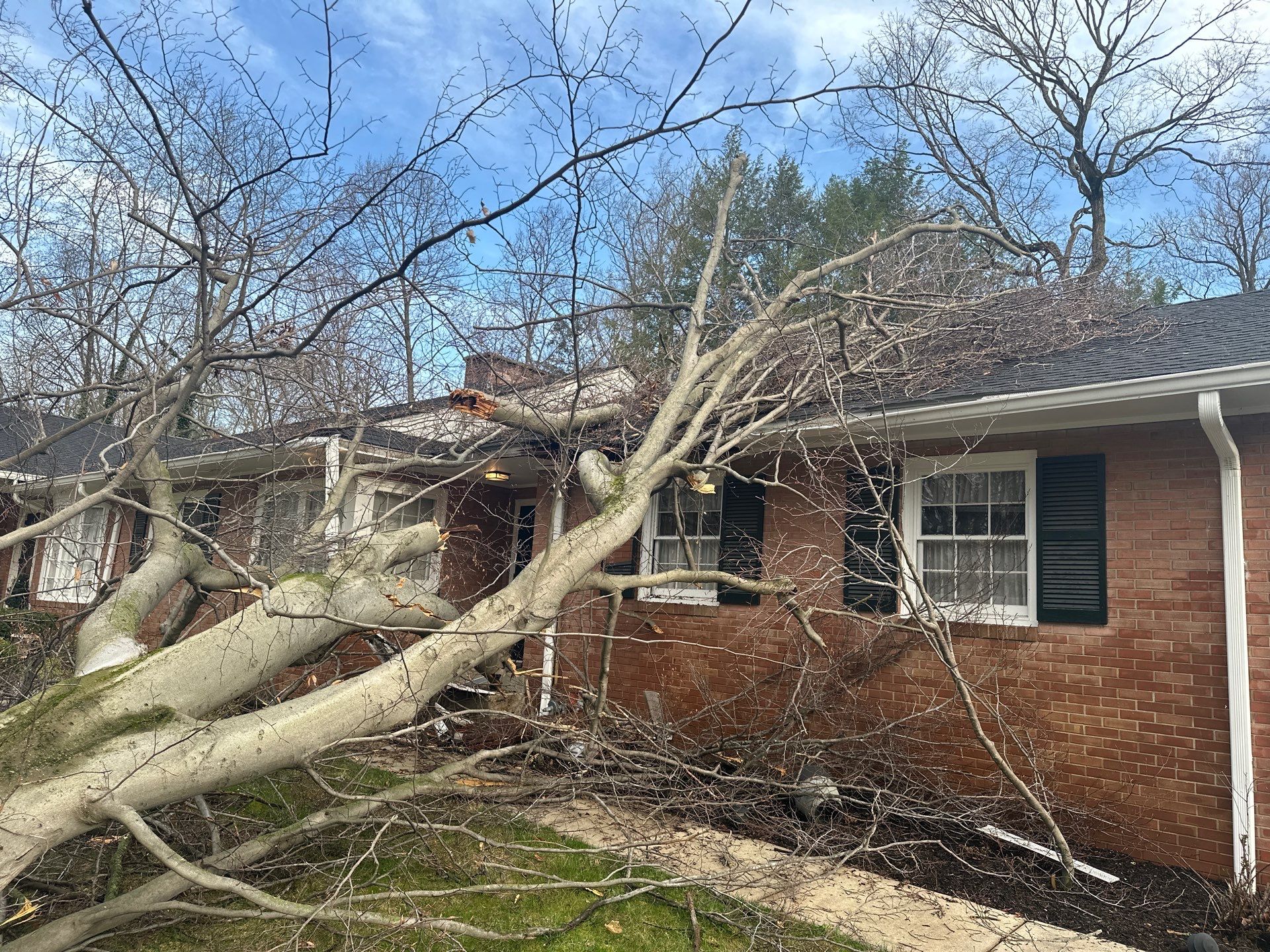
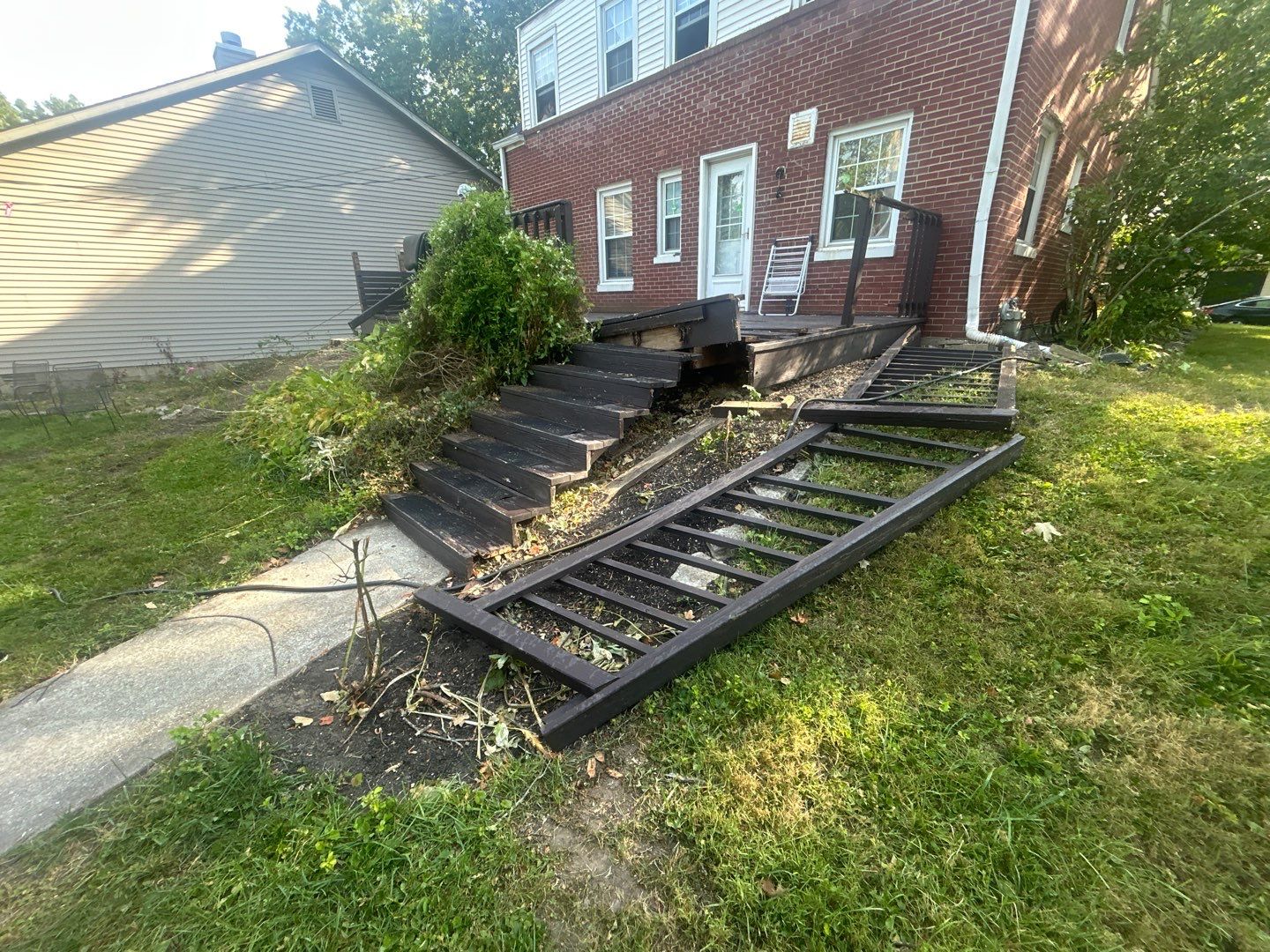
- Hendricks County Emergency Management reported 20 homes destroyed or damaged. In Danville, a massive uprooted tree hit a home, taking out the front porch and toppling the brick chimney.
- Downed power lines in Danville led to a fatality — a serious reminder that downed lines can energize the ground around them.
That wasn’t an isolated night. Central Indiana has been in an active stretch: significant outbreaks in March 2023, March 2024, March 2025, and April 2025, plus repeated derecho and straight-line wind events. You can pull the survey record for your own address through the National Weather Service Indianapolis office.
So — is this the new tornado alley?
Honest answer: Indiana has always been tornado-prone. Central Indiana sits near the northern edge of the traditional belt, and Hendricks County’s history runs deep — the county was devastated in a 1948 tornado, with violent tornado records going back decades before that.
What has changed is the clustering. The last several seasons have brought multiple significant events per year rather than one memorable storm per decade. Whether that’s a long-term shift or a run of bad luck is a question for climatologists, not roofers.
The practical takeaway doesn’t depend on answering it: if you own a home here, plan around the possibility of a significant wind event every single year.
The real Danville storm damage roof threat isn’t the tornado
Here’s what surprises people. The leading cause of catastrophic roof damage in Hendricks County isn’t the tornado core — it’s trees.
Tornadoes are narrow. Straight-line winds are wide. An EF-2 might affect a path a few hundred yards across, but the 60–80 mph straight-line winds accompanying the same system hit entire counties at once. Those winds don’t need to be tornadic to put a mature hardwood through your roof.
Danville and the older sections of Brownsburg have exactly the profile that makes this expensive: established homes with mature tree canopy planted close to the structure. That canopy is why people love these neighborhoods. It’s also why the emergency calls come.
Reducing your tree-strike risk before the next storm
You can’t prevent a storm. You can meaningfully change the odds.
Assess your trees honestly.
- Any tree tall enough to reach the house if it falls deserves evaluation.
- Look for dead limbs, cavities, fungal growth at the base, splits in the main trunk, or a lean that’s worsened.
- Watch for soil heaving on one side of the base — a root-plate warning sign.
- Ash trees deserve special attention given emerald ash borer damage across Indiana. A dead ash is brittle and unpredictable. Purdue Extension publishes guidance on tree health and hazard assessment.
Prune Strategically
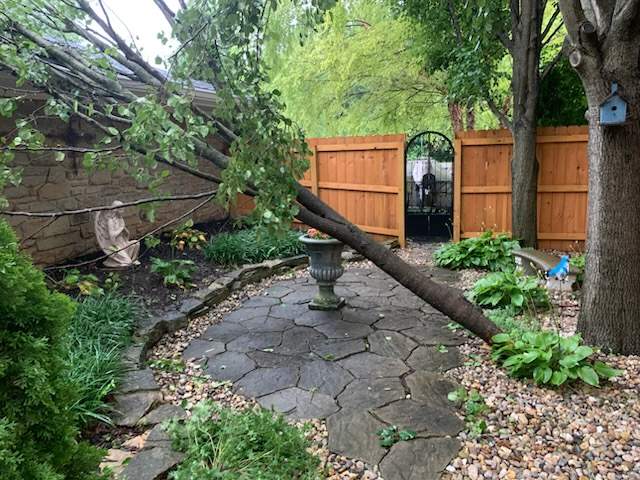
- Remove limbs overhanging the roof where practical.
- Clear deadwood — dead limbs come down first and hardest.
- Hire a certified arborist, not someone with a chainsaw and confidence.
Reduce the secondary damage.
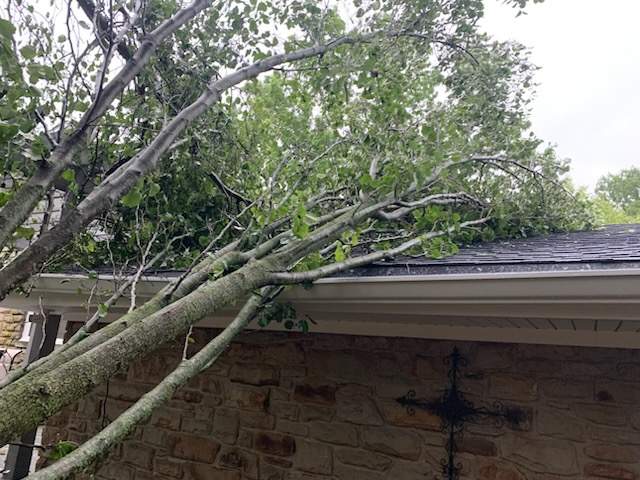
- Overhanging limbs abrade shingles in ordinary wind, not just storms.
- Leaf litter clogs gutters and valleys, which causes ice dams in winter.
- Shaded, damp roof sections grow moss and algae, shortening shingle life.
Prepare for the aftermath.
- Know who to call for emergency tarping before you need to.
- Keep dated photos of your roof and exterior in good condition. A “before” photo is extremely useful in a claim.
- Know where your insurance documents are.
If a tree hits your roof
- Get everyone out and stay away from downed power lines. A downed line can energize the ground well beyond the line itself. Treat every line as live. The Indiana Department of Homeland Security publishes storm safety guidance worth reviewing before a storm, not after.
- Don’t remove the tree yourself. A tree resting on a structure is under load in ways that aren’t obvious, and cutting it wrong drops the rest through your roof.
- Call for emergency tarping to stop water intrusion. Every hour of open roof adds interior damage.
- Photograph everything before anything is moved — the tree, the roof, the interior, the contents.
- Call your carrier. Tree-strike damage to a structure is generally a covered peril, though coverage for tree removal often carries its own sublimit.
- Get the roof structure assessed, not just the shingles. Impact loads crack rafters and damage decking well beyond the visible hole.
Watch out for storm chasers
After every Hendricks County event, out-of-state crews arrive, knock doors, and disappear once checks clear. Before signing anything:
- Verify licensing and insurance directly with the insurer, not the salesperson
- Get a local address and ask how long they’ve worked in Indiana
- Never pay large sums up front
- Be skeptical of anyone offering to “cover your deductible” — that raises real legal issues
- Get scope and warranty terms in writing
Frequently asked questions
Does insurance cover a tree falling on my house? Damage to the structure from a fallen tree is typically covered under standard homeowner policies. Removal of the tree itself often carries a separate, limited sublimit. A tree that falls without hitting anything is frequently not covered at all. Read your policy.
What if my neighbor’s tree falls on my house? In most cases it goes through your own policy — unless the tree was demonstrably dead or hazardous and the neighbor was notified and did nothing. That’s legal territory; talk to an attorney if it applies.
Should I remove healthy mature trees near my house? Generally no. Healthy, well-maintained trees add real value and shade. Focus on removing genuinely hazardous trees and pruning strategically.
How fast can I get emergency tarping after a Danville storm damage roof event? Call as soon as it’s safe to do so. After a widespread event, crews book quickly — the homeowners who call first get covered first.
Storm-ready in Danville and Brownsburg
Moss Roofing provides emergency tarping, storm damage inspection, insurance claim documentation, and full roof and siding replacement throughout Danville, Brownsburg, Avon, Plainfield, Pittsboro, Clayton, and Hendricks County.
If the last few seasons have made you nervous about your roof, get a free inspection and know where you stand.


